
South Punjab changes the rhythm of a Pakistan journey. The landscape opens, the palette shifts toward desert earth and blue ceramics, and centuries of spiritual, mercantile and royal history come into view.
South Punjab at a glance
- Heritage status: Uch Sharif’s principal monuments and Derawar with the Desert Forts of Cholistan are on Pakistan’s UNESCO Tentative List. They are not currently inscribed World Heritage Sites.
- Best time: October to March. November to February offers the most comfortable conditions for Cholistan; summer temperatures can be extreme.
- Recommended stay: Four days for a focused route; five to seven days for Multan, Uch Sharif, Bahawalpur and Cholistan at a measured pace.
- Main gateways: Multan and Bahawalpur are accessible by road, rail and domestic air connections. Bahawalpur is the practical base for private excursions into Cholistan.
- Journey style: A private vehicle is the most effective way to connect the dispersed heritage sites. Desert visits require advance planning, reliable transport, water and locally informed arrangements.
Multan, the historic city of saints
Multan has stood for centuries at a meeting point of routes linking Central and South Asia. Its identity is inseparable from Sufi traditions, most visibly expressed in the monumental shrines rising above the old city.
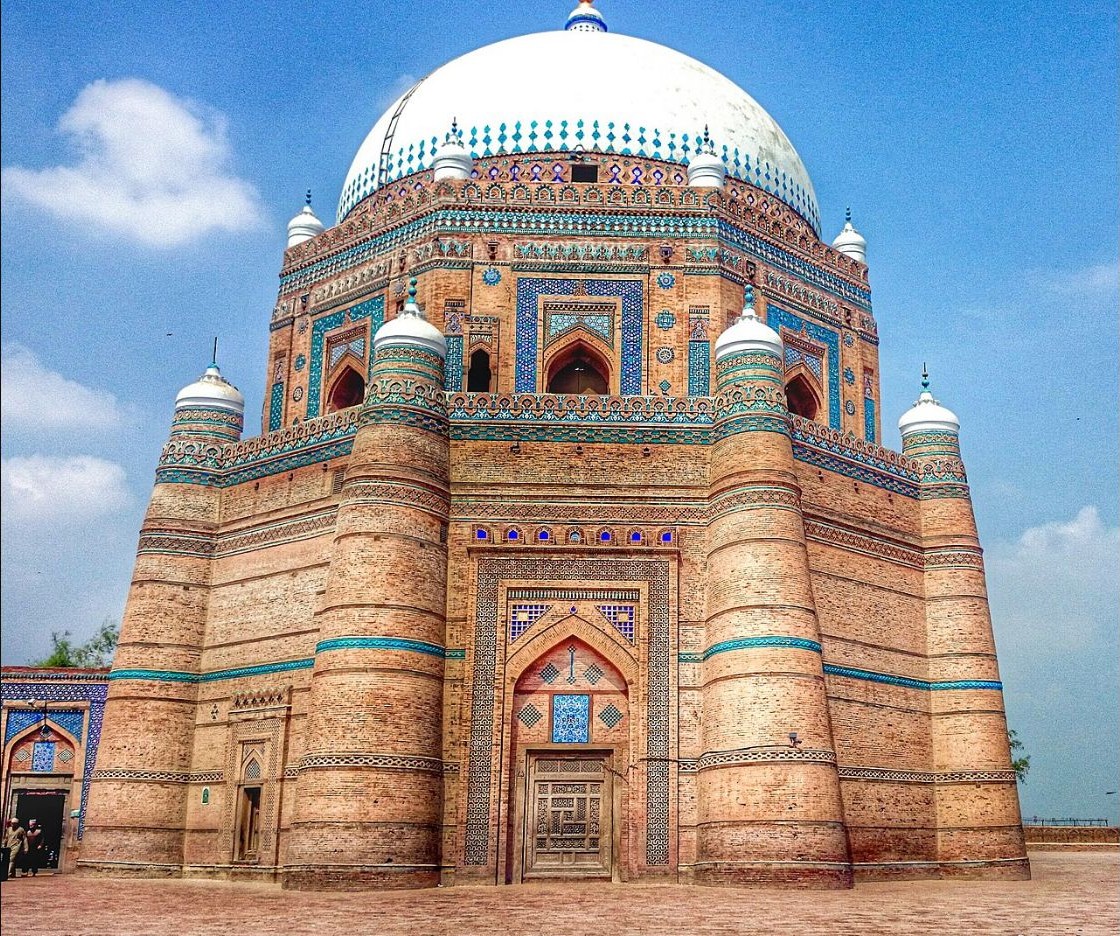
The shrine of Shah Rukn-e-Alam belongs to the early 14th century and is one of Multan’s defining landmarks. Its powerful brick mass, timber structure and blue-and-white tilework established an architectural vocabulary echoed across the region. Exploring it with context reveals more than a monument: it remains part of a living spiritual landscape.
The city’s bazaars and workshops introduce Multani blue pottery, embroidery, textiles and other traditions that continue to support local makers.
Uch Sharif: medieval architecture and UNESCO Tentative status
Uch Sharif contains a remarkable group of Sufi monuments. The tomb and mosque associated with Jalaluddin Bukhari date from the 14th century. The distinctive tomb of Bibi Jawindi was built around 1494 and is known for its octagonal form, tapering towers and blue-and-white faience mosaic decoration.
Pakistan submitted the Tomb of Bibi Jawindi and related monuments at Uch Sharif to UNESCO’s Tentative List on 30 January 2004 under proposed criteria (ii), (iv) and (vi). Tentative listing is a step that may precede nomination; it should not be described as full World Heritage inscription.
Bahawalpur and the former princely state
Bahawalpur developed as the centre of a princely state ruled by the Abbasi dynasty. Today it is the natural base for exploring palaces, bazaars and the Cholistan Desert. The city’s architecture and courtly history give it a character distinct from Lahore and Multan.
Distances in this region can be deceptive. A well-planned journey should allow time for road conditions, site access and the slower pace required for meaningful encounters beyond the cities.
Derawar and the Desert Forts of Cholistan
Derawar is the best-preserved of a network of desert forts that protected water sources and caravan routes. UNESCO’s official Tentative List record traces its origin to the 9th century, when it was built by the Bhatti Rajput ruler Rai Jajja. The Nawab of Bahawalpur, Sadeq Mohammad Khan I, took the fort in 1733; it returned to Bahawalpur control in 1804 after an intervening loss.
The present complex has forty circular bastions. Its walls extend for roughly 1,500 metres and rise to about 30 metres, creating one of Pakistan’s most recognisable desert silhouettes.
Derawar and the Desert Forts of Cholistan were submitted to UNESCO’s Tentative List on 12 April 2016 under proposed criteria (iii) and (v). The record describes a wider defensive network, including Meergarh, Jaangarh, Marotgarh, Maujgarh and other forts associated with water, trade and pilgrimage routes.
How to get there
Multan: Reachable by domestic flights, rail and major roads. It works well as the first stop when approaching from Lahore or Islamabad.
Uch Sharif: Best included by private road between Multan and Bahawalpur. A dedicated vehicle allows time at the monuments without depending on limited local transport.
Bahawalpur: Accessible by air, rail and road, and the most convenient urban base for Cholistan.
Derawar and Cholistan: Travel by prearranged private vehicle with an experienced local team. Access permissions and entry conditions can change, so they should be confirmed before departure. Avoid independent desert driving.
Connecting the wider Pakistan story
South Punjab fits naturally between Lahore and Sindh, creating an overland journey through Mughal cities, Sufi centres, desert heritage and the ancient landscapes of the Indus. It can also stand alone as a privately arranged cultural experience shaped around architecture, photography, craft and local history.
Explore the South Punjab destination guide →
Plan a private journey across Pakistan →
Heritage note: UNESCO status, submission dates and the main historical details for Uch Sharif and the Cholistan forts were checked against the UNESCO World Heritage Centre’s official Tentative List records. Local access and transport arrangements should be reconfirmed for the intended dates.